Lyn Aylward’s paintings are concerned with the human figure, portraying people from different backgrounds, in both figurative, narrative works and more traditional portraiture. Her distinctive, realist paintings also explore human relationships, family ties and recollections of childhood.
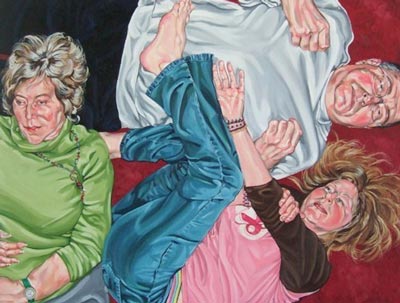 |
| Family (from on high) oil on canvas ©Lyn Aylward |
Take five with… is an ongoing series of informal interviews with Artworks artists. Without further ado, let’s ‘take five‘ with the figurative painter Lyn Aylward, who is a new member of Artworks.
Which person most encouraged you to first become an artist?
My mother first encouraged me. She studied to be an art and history teacher at Southampton during the 1960s and had (and still has) a wonderful sketchbook that she worked in that is filled with portraits and figurative studies of her room mates and friends during her time there. I have always wanted to have a sketchbook that was half as good as hers and I definitely haven’t managed it yet!
Which living artist do you most admire and why?
Chuck Close, whose work is beautiful and for bringing the portrait back into fashion when it was no longer considered to be a modern art form. He is an inspirational artist who comes up with gems such as ‘problem solving is way too overrated‘. ‘Problem creation is much more interesting‘ and painting is ‘coloured dirt smeared on a flat surface, usually stretched around some wooden sticks‘.
 |
| Self Portrait, oil on canvas, 2000-2001 ©Chuck Close |
Whereabouts in the world is (or has been) the most inspiring location for you as an artist?
I visited the Metropolitan Museum of Art in New York in 2009 and I have to say that when I walked into the room that housed the Chuck Close, Andy Warhol and Alex Katz works I found myself in heaven. I was on holiday with my cousins and they had to sit and wait for me for at least quarter of an hour whilst I stood in front of the Chuck Close ‘Lucas’ painting alone. There are many fantastic works of art in the museum and I really would like to go back and spend a lot longer there. My cousins presented me with a printed bag after the trip which includes a photograph on the front of me standing in front of the ‘Lucas’ painting. I obviously stood there for what seemed like ages to them but nowhere near long enough for me!
 |
| Lucas, oil on canvas, 1987 ©Chuck Close |
What do you listen to while creating – music, a radio station, or do you work in silence?
I am a huge fan of all types of music so often have music playing when painting. The type of music depends on what I am working on at the time. I mostly listen either to a classical film soundtrack or classical music as it is the only way to stop me singing along to songs and losing my concentration! Or it has to be something sung in a different language to keep me from joining in or an audio book – usually Agatha Christie. The golden rule for me is to NEVER put anything on that can be danced to as that just leads to some very dodgy dance moves and some shaky painting!
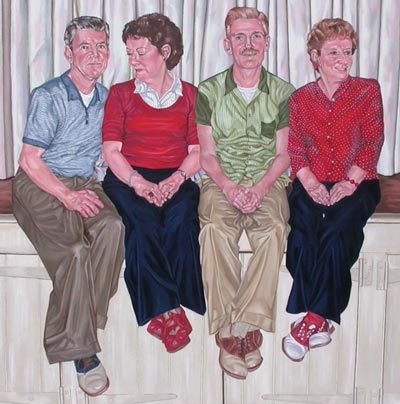 |
| Dance Teachers, oil on canvas, ©Lyn Aylward |
How do you generate or develop ideas for your art?
I tend to scribble ideas on bits of paper and I do have an ‘ideas’ book that I paste into any scribbles, photos or pictures that I think might inspire me at some point. I am inspired by other artists, photographers, film, books and often the people around me so ideas can spring from anywhere.
 |
||
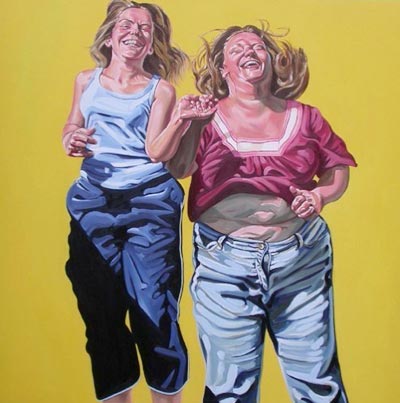
| Clare and Katie Leaping, oil on canvas ©Lyn Aylward |
Could you describe your art studio set-up.
One room, no running water, no heating and the scariest steep staircase but it has wonderful big windows so excellent light. Brilliant in the summer but freezing in the winter!
What time in the day are you at your most creative?
Definitely during the morning and the worst time is during the evening.
What is the purpose of drawing for you as an artist?
Drawing is incredibly important for me. I always begin paintings with preparatory sketches. I never go straight to the canvas. Plus I think that even if my sketches are not brilliant, they have helped me to really look at my subject so that when I get to the stage of working on canvas I have already got a good feel for the subject/sitter.
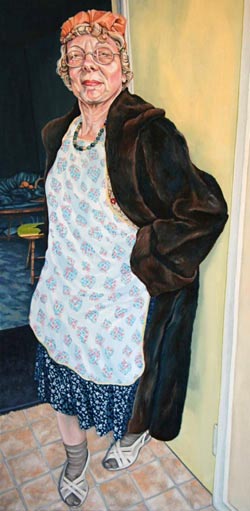 |
| Delusions, oil on canvas ©Lyn Aylward |
Is there an art medium/technique you’d most like to try but haven’t yet?
I have never tried etching and I would love to try this as I like the idea of being able to have more freedom to draw than some of the other printing methods. I have only printed using lino, lithography and collagraph to date.
If you had to choose between using a pen or a pencil – which one and why?
I would always choose a pencil. The way that you can make different marks with a pencil is the reason why. Plus you can start a sketch using very light marks so that you are able to correct any mistakes and I find that a pencil enables me to give more tone than ink.
Do you have a personal motto?
I heard Antony Gormley say this in a TV documentary and I have stolen it for my own motto! It is on the back of an envelope and pinned to the wall in my studio. It is ‘what is worth doing, do it completely and tell it like it is‘.
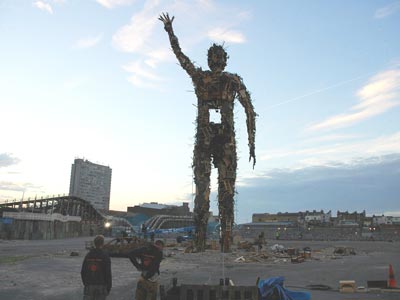 |
| Waste Man, 2006 ©Antony Gormley |
Thank you very much Lyn, for ‘taking time out‘ for the Artworks blog – we appreciate the insight into your creative world! Read more about Lyn Aylward‘s work on the Artworks website or view more of her paintings on her own website: www.lynaylward.co.uk
In addition to being a new artist with Artworks in 2011, Lyn Aylward is also an active member of the Norfolk Artists group Breckland Artists. She exhibits her work at a number of galleries throughout East Anglia and also accepts portrait commissions.
There will be another ‘take five‘ artist interview on the Artworks blog soon, so stay tuned…

 Artworks