Category Archives: artist interviews

Take five… with the artist, in the studio, on making art, ideas & inspiration.

Take five with… printmaker Janet French

This week, the Artworks blog has a ‘take five’ chat with artist printmaker Janet French. Janet’s artistic process & practice is concerned with nature and the environment:

‘My work explores the fragile symbiotic relationship between man and the natural environment. I work in tune with nature to create work that is testimony to my interaction with materials, conditions, seasons and weather.’
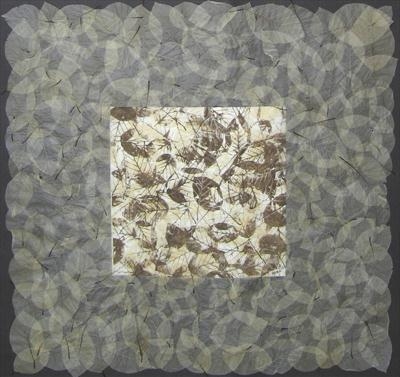
Janet French, Fagus Diptych – Part One, 62cm x 62cm

Nature, landscape and the environment seems to be a strong theme in much contemporary art. In your own work, you use natural materials such as beech leaves to create handmade paper which you then use to print on.

Are there any contemporary artists that you particularly admire?
Environmental artists like Chris Drury, Richard Long and David Nash most interest me because I share the desire to work with the available materials in the environment.
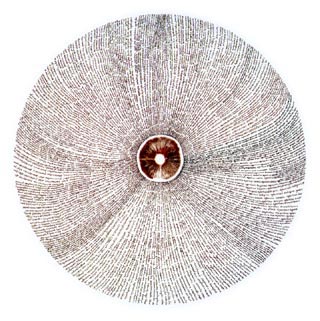
Chris Drury, Mushroom Circle, 1995 © Chris Drury

How do you generate or develop ideas for your own art?
My ideas often come from unexpected sources. A few years ago I joined a group of London artists in an exhibition in Bethnal Green. The common theme among the group was ‘earth’ and I decided to look at satellite images to see what earth could be seen in the area of the gallery. This sparked a continuing fascination with aerial views. Other ideas simmer away for years, occasionally rising to the surface but never quite resolving in to finished work.
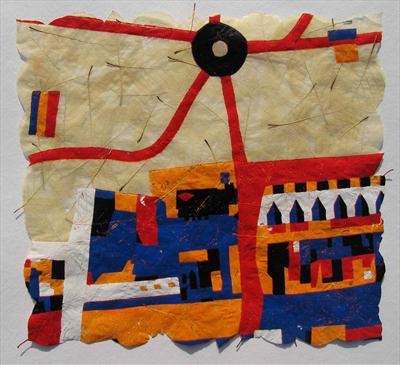
Janet French,  Bethnal Green, 54cm x 56cm

Could you describe your art studio?
My studio space is a converted garage. It is full of bags and buckets of leaves and fibres in various stages of papermaking production. I have a small table top printing press which is good for small work and for working through ideas. For larger work I go to Gainsborough’s House Print Workshop which has a wonderful range of printing presses. I like to plan a piece of work and make the paper in my studio at home and then produce the finished print at Gainsborough’s House.

What do you listen to while working in your studio?
Turning the radio on to Radio 4 is part of the ritual I go through as soon as I enter my studio, along with lights, heater, overall etc. Whether or not it stays on depends on what I’m doing. If I’m preparing paper or clearing up ink I like to listen but as soon as I’m doing something creative I turn the radio off. In a typical day I never seem to hear a whole programme.

What time in the day are you at your most creative?  
I am always up early and most creative in the morning. If I get off to a good start early, I can keep going until about 5pm but I can never work in the evening.

What’s in your current sketchbook?  
My present sketchbook has become a great unwieldy heap of drawings, photos and notes on scraps of paper, all of which relate to my present obsession of light seen through trees.

If you had to choose between using a pen or a pencil to draw with – which one and why?  
I prefer pen to pencil and particularly like water soluble ink pens with watercolour paper. I like to draw quickly, add some water, and when it is dry work back into the drawing with pen.

What do you think is the role of an artist in contemporary society?
One of the by-products of creativity is the ability to see things in a different way and to present new ideas in a way that no one has seen before, as well as highlighting beauty and the expression of human emotions. In some cases, artists are in a position to reach multitudes of people by using their status to bring attention to a worthwhile cause or environmental issue. For example, Richard Long’s Africa Mud Maps, which Long has made for auctions and whose proceeds have contributed to aid for the developing world.
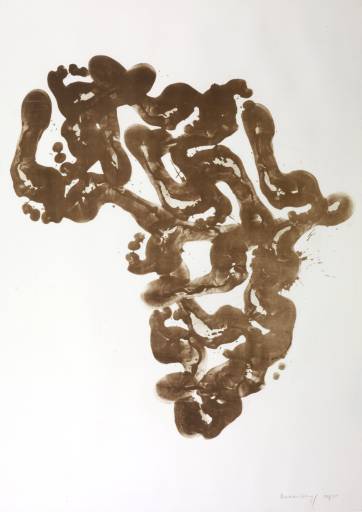
Richard Long, Africa Footprints 1986 © Richard long (collection TATE)

One of the most interesting things that artists can do is spur public conversation and in future I may find that I am able to draw attention to endangered species or threatened habitat through my own work. I am currently working on a collaborative print project with another printmaker Emma Buckmaster, and our aim is to produce a series of tree portrait etchings on related leaves.
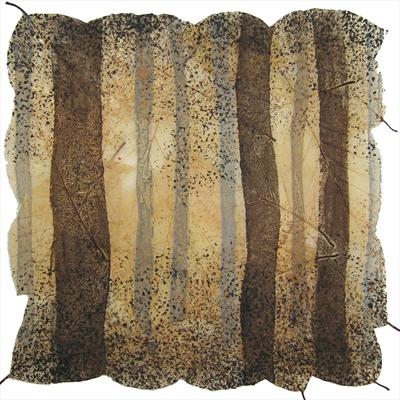
Janet French, Into the Light, mixed media on beech leaves, 34cm x 32cm

Thank you Janet for sharing a little of your creative world with the Artworks blog!

Janet French has a BA (Hons) in Fine Art from Colchester School of Art. In addition to Artworks, Janet is currently Joint Chairperson of Gainsborough’s House Print Workshop, and is a member of the Essex Art Society and the collaborative artist group Nine Artists.

Originally from London, Janet French has lived in Essex for twenty five years. You can read more about Janet’s environmental artworks on her Artworks page or visit www.janetfrench.co.uk.

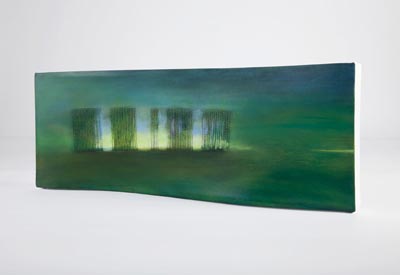
Take five with… Eleonora Knowland, abstract painter

The Artworks blog today ‘takes five’ with the painter Eleonora Knowland. Eleonora’s minimal, abstract paintings are much informed by the rural landscape where she lives, as she explains:

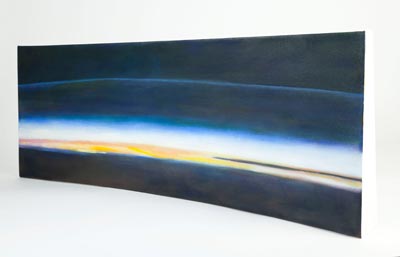
Time spent in contemplation reveals the subtle beauty of the Suffolk landscape which is reflected in my paintings. Muted colour expresses the tranquillity, harmony and immensity of the horizon that is around my Suffolk home. The Suffolk landscape is full of moments of excitement, colour and light, and I am interested in trying to understand what I am experiencing when I see them.

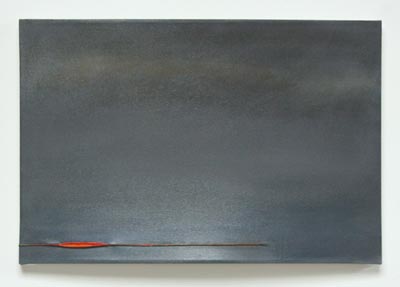
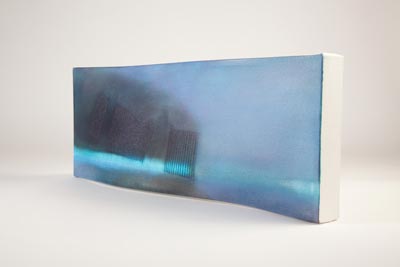
© Eleonora Knowland, 04.16 summer, oil on canvas

I have developed a technique of stretching a manipulated canvas over a curving stretcher, which echoes the soft rolling undulations of the landscape but also creates an interaction with the viewer. Moving around the painting, diverse aspects become dominant, the light catches it differently down a slope, the eye is attracted by a row of stitching, interesting shadows are thrown onto the wall. The stitched lines in the structure of the canvas allude to agricultural and habitation practices that have shaped the landscape we see.

The perception of colour in your paintings is very subtle, understated, minimal, layered – do you have a favourite colour (in life or your art)?
Blue, it is the colour I understand most and I find the easiest to paint in, which could be considered a handicap for a landscape painter. My recent paintings in green have given me more confidence with the colour.

© Eleonora Knowland, 11.58 summer, oil on canvas

The titles for your paintings are very intriguing too, also quite minimal. How do come about or decide on what you will call them?
A trick one this. For a few years I have been calling them times of day and the season. For example ‘8.11 Winter‘ but my current work will have some reference to light, the preliminary work will refer to the final piece.

Eleonora Knowland, 8.11 winter, oil on canvas


How would you summarise your art in just a few words for someone completely new to your work?
It would be calm, followed by full of colour, enigmatic, abstract, and layered.

What are you working on at the moment?
My current work has been building towards a single painting from an initial photograph I took a few years ago. I developed ideas in a sketch book, then sketches in oil on watercolour paper, then oil on oil-ready paper, two studies on canvas and now I am beginning the final piece. This will of course not actually be final as I expect this subject will bug me for many years to come.

Could you give us a picture of your studio space/set-up?
I work in a converted 1950’s grain store beside my home. My industrial sewing machine is in one corner ready for me to stitch on the canvas for some of my paintings. There are my unsold paintings and drawings of nudes on the wall. More paintings lean against the shelving, they stack really badly because of the curved canvasses.

Do you have any music playing while you are painting in your studio?
I listen to a variety of classic and solo artists on my ipod. What’s a typical working day for you as an artist: Up early, a few household chores, painting or stretching canvas etc. As I paint in layers of oil paint and I only work on a couple of paintings at a time I have usually done what I can by lunch. Occasionally I will return in the afternoon if I am stretching and priming a new canvas. Dig the vegetable garden etc, walk the dog etc do “stuff” cook, eat sleep start again.

And what time in the day are you at your most creative?
In the morning. I paint after breakfast then garden or do whatever after that.

© Eleonora Knowland, 12.15 Treshnish Isles, oil on canvas


Is there a contemporary artist whose work you particularly admire?
The Irish painter Felim Egan. His abstract landscapes have a clarity and spatial understanding that I find very uplifting.

What have you discovered from looking at the work of other artists, such as Egan?
That thin unseen layers of paint lift a painting from the ordinary to the extra ordinary.

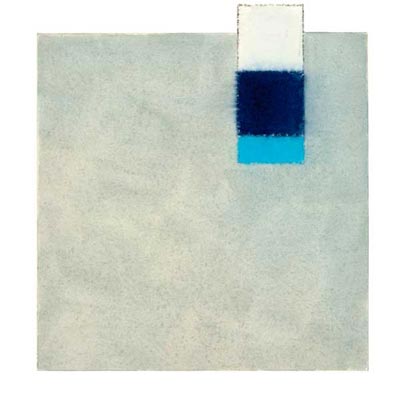
Felim Egan, Tideline g, watercolour on paper, 2005

Can you remember the first work of art you ever saw for real?
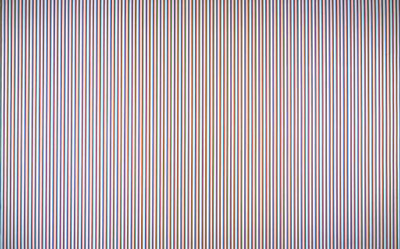
I remember a Bridget Riley Op Art painting during the 1960’s. Her paintings were very exciting. What’s your first memory of creating art and what was it? I remember painting a wave on a sheet of 4ft x 8 ft hardboard with a friend when I was about 15. I went to a very “arty” school form the age of 10/11 so I have many memories of creating everything from copper pots through books to dresses and paintings.

That’s very interesting, that you should recall painting a wave, with reference to your own curved canvases and the paintings of Bridget Riley.

Bridget Riley, Late Morning, 1967-8, (collection TATE)

If you could select one famous artist to invite to dinner (dead or living, it’s not a problem) who would it be and what question/s would like to ask them?
Turner. I would ask about how he saw the world and why he painted in such a colourful abstract way.

JMW Turner, Norham Castle, Sunrise  c.1845 (collection TATE)


Is there a famous artwork or painting you would really like to own, assuming money & space is not a problem? 
I would happily house anyone of the more enigmatic Turner’s, a Rothko or a Felim Egan.

Mark Rothko, Untitled, oil on canvas,  c.1950-2 (collection TATE)

We all have opinions about art. Is there one work of art (contemporary or historical) that you don’t like – and if so, why?  
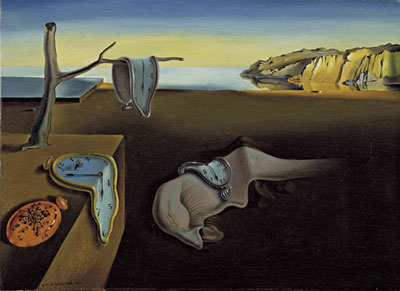
Salvador Dali’s ‘The Persistence of Memory‘. I find it really interesting but the paint is too smooth and it feels slick to me.

Salvador Dalí, The Persistence of Memory, oil on canvas, 1931 (collection MOMA)

Drawing is talked about a lot as a fundamental aspect of creating art, what is the purpose of drawing for you as an artist?
Drawing reminds me to look, to see really carefully. Photographs are helpful but to really understand, a few minutes with pencil or crayon in hand makes all the difference.

What single piece of advice would you give to a budding, aspiring artist?
Draw/sketch every day.

So, what’s in your current sketchbook?
It is full of studies on one photo of light seen through trees.

Is there an art medium/technique you’d like to try but haven’t yet?
I would like to do some more work with print. I did some printmaking during my degree but would like to develop it more.

© Eleonora Knowland, Atmosphere IV, oil on canvas

The East Anglian landscape is clearly very inspiring to you as a painter, but the ‘Atmosphere’ series of paintings suggest a different direction. Is there a place in the world that you’d really like to visit, as a new source of inspiration?  
I would like to visit the Antarctic.

If you were stranded on a desert island (or Antarctica!) without any art materials or equipment what would you most miss using?  
Canvas.

Lastly, lots of people like to ask this simple question of artists – why do you make art?
I have to.  

And what do you think is the role of an artist in contemporary society?  
It’s impossible to say as I think they fill many roles. My role as an artist may be to make people look about them and see the beauty in everyday surroundings.

Many thanks Eleonora!

You can see more of Eleonora’s distinctive paintings on her Artworks profile page, or visit her own website, eleonoraknowland.co.uk

Eleonora Knowland had a successful career in interior design and fashion before studying Fine Art at Colchester School of Art and Design, where she graduated in 2006 with a First Class Honours degree. Married to a Suffolk farmer, she has lived in East Anglia for over 30 years and much of her creative inspiration is derived from the subtle beauty of the open Suffolk landscape. She has exhibited in both East Anglia and London.

Take five with… Helen Dougall, batik artist & painter

Welcome to a brand new series of articles on the Artworks blog. It’s called quite simply ‘Take five with…‘ – and it aims to be an engaging & informal introduction to each one of our Artworks artists. Without further ado, let’s ‘take five‘ with batik artist & painter Helen Dougall…

Firstly, Helen tells us a little about what inspires her as an artist and how she makes her batik paintings.

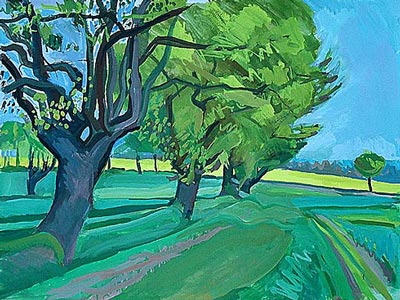
I have always been interested in landscape in all its diversity, after my childhood in Wales and now living in Suffolk, but also the visible effects that man has made, negatively and positively, on the landscape. Expressing “a sense of place” and my reaction to it is important to me. I paint and draw directly from observation, in an effort to capture the complete essence of landscape.

© Helen Dougall, Oil Seed Rape Field with Trees, gouache on paper

My drawings and paintings, mainly in gouache or aquarelle pastel are always done on the spot. These media have an immediacy which enables me to express my interest in space and colour. These ideas also have a particular affinity with the craft of batik, in the way molten wax can be painted or drawn across dyed fabric to produce textural effects.

To make a batik painting, selected areas of fabric are blocked out with molten wax and then the fabric is dyed. The waxed areas resist the dye, while un-waxed areas absorb the dye. The process of waxing and dyeing is repeated by waxing or blocking out areas on the dyed fabric after it has dried, then dyeing it a different colour.

Because dyes are transparent, the second colour is changed by the first colour e.g. a blue over yellow will produce green. Some of my batiks are immersed up to seven or eight times, usually starting with the lightest colour and progressing through medium tones, finishing with the darkest colours.

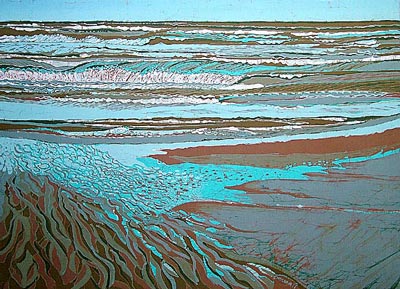
© Helen Dougall, Sand and Sea, batik wall-hanging

A particular effect of successive dyeing is the harmonious, layered combination of colours, i.e. apart from the first colour all the following ones are combinations of all the preceding colours. Another effect is the emergence of fine hair-lines within the design, caused by the wax cracking in the dye bath, or it is deliberately “crunched” to produce a subtle “crackle” effect.

Sometimes the dyes are selectively painted on rather than immersing the whole fabric in the dye bath. After the final dyeing the wax is later removed from the fabric by ironing & blotting between sheets of newsprint to reveal the final design. The piece is then dry-cleaned, washed, dried and mounted on a frame much like a canvas.

An awareness and sense of colour is obviously very important to you as an artist. What is your favourite colour & why?
A bluey-greyey-green, the colour of the sea on the west Wales coast. The Cardiganshire and Pembrokeshire coast are very inspiring locations in addition to the landscape of East Anglia. I am particularly interested in the effect of sunlight across stubble fields, or seascapes with wet, shiny undulating beaches or multicoloured shingle.

© Helen Dougall, Beach Watermarks, batik wall-hanging

So, for someone completely new to your art, how would describe it in just a few simple words?
Subtle, colourful, textural, feeling, atmospheric, and ‘landscape’ is a word I use quite a lot in reference to my work.

Why do you make art?
It sounds corny, but I need to be creative. So, how do you generate or develop the ideas for your work? Lots of drawing from observation, taking photographs and improvising, with different visual ideas.

Could you describe your studio space/set-up.
My studio is a converted farm building, a cart shed adjoining an old stable and barn, it’s long and low and it faces south, so we put in a north-facing roof-light, and it looks out onto a secluded garden.

Your studio sounds wonderful! What’s a typical working day for you as an artist? 
The morning is mostly devoted to domestic chores, paperwork and e-mails, sometimes dog-walking and looking out for places that are interesting to draw. Afternoon and sometimes evening, is when I retreat to my studio, or if the weather is good, I go out with my easel and paints. If I’m working in batik, after spending a long time painting and drawing wax on cloth, I soak the whole piece in dye. While it is drying, and before I can continue with it, I might go and hoe a row of carrots! What time in the day are you at your most creative, do you think? Around mid afternoon.  

And, what do you listen to while creating?
I listen to the radio and classical or jazz music.

Would you care to share what’s in your current sketchbook?  
Drawings of raised furrows across a field where I think onions have been planted.

© Helen Dougall, Preseli Fields, batik wall-hanging

Which living artist do you most admire and why?
Howard Hodgkin. Fantastic colour and being able to describe a feeling or place in abstract terms with such an economy of incredibly sensitive brushstrokes.  

So, that leads nicely to the question, which famous artwork would you most like to own, if money & space was not an issue?  
One of Howard Hodgkin’s paintings, possibly ‘Blue Remembered Hills’.

Howard Hodgkin, Blue Remembered Hills, oil on wood 2002-03

Could you name one work of art (contemporary or historical) that you don’t like – and why?  
Richard Hamilton’s ‘Just what is it that makes today’s homes so different, so appealing?‘. It describes an age I was trying to move away from, it makes me cringe – so I suppose it was effective in its intentions!

Richard Hamilton, Just what is it that makes today’s homes so different, so appealing? 1956

Share something unusual you’ve learnt from looking at the work of other artists.
Nostalgia, such as looking at Eric Ravilious’s watercolour, ‘An Attic Bedroom‘, the camp bed in a bare-boarded, cluttered room; it reminds me of childhood summer holidays.

Eric Ravilious, An Attic Bedroom, watercolour on paper, 1932-34

Which artist (dead or living) would you fancifully like to invite to dinner and what question/s would you ask them?  
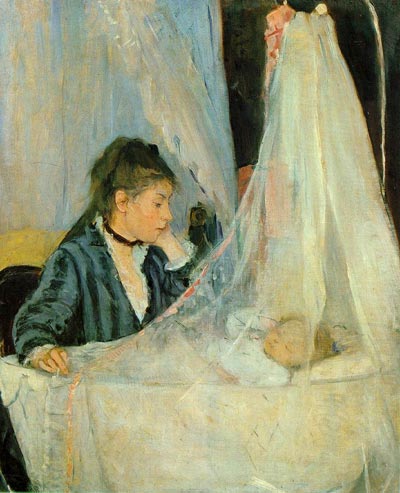
Berthe Morisot. What was it like being almost the only woman painter (of note), surrounded by so many men painters at the end of the nineteenth century in France? Also, what was her attitude to motherhood after her painting of ‘The Cradle‘ ?

Berthe Morisot, Le Berceau (The Cradle), oil on canvas, 1872

That’s a very interesting point regarding female artists in society. What do you think is the role of an artist in today’s society?  
To reflect good and bad things; I tend to go for the aesthetic.

Students of art might be reading this with great interest, so what single piece of advice would you give them to make it as an artist?
Keep following your hunches and learn many hand-skills, drawing, painting, printmaking, working in 3D, as many techniques as possible because art schools have tended to offer fewer in recent years.

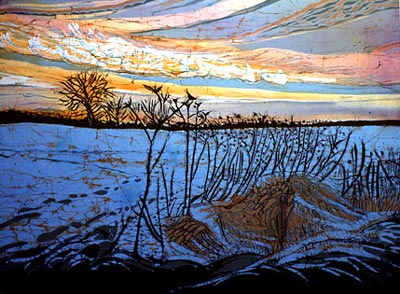
© Helen Dougall, Snow Field, batik wall-hanging

And lastly, what is your personal motto (if you have one)?  
Get something done each day, however insignificant.

Thank you Helen, for a small glimpse into your creative world, and that’s a very good note to end on! I am sure our readers will be inspired. There is clearly a lot of time & skill involved in Helen’s incredibly detailed batik paintings and she explains the many stages of creating one her batiks, ‘The Snow Field‘ (shown above), on her own website.

Helen also runs short courses in batik techniques; further details can also be found on Helen Dougall’s website.

Helen Dougall studied fine art at Chelsea School of Art and then trained as an art teacher. She taught in London and then Suffolk for many years, pursuing her own art full-time from 1997. Helen is a member of the Batik Guild, the Suffolk Craft Society and Artworks.